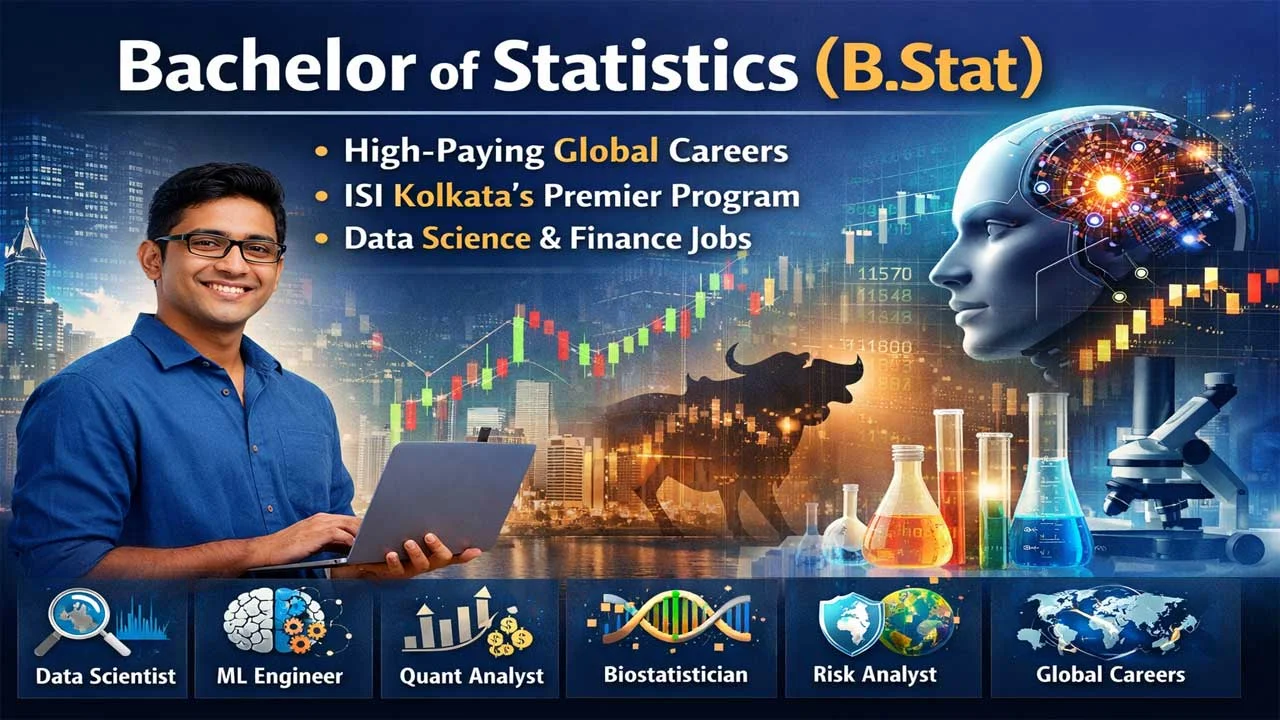
Bachelor of Statistics (B.Stat.)
Develop strong mathematical, statistical, analytical, and data interpretation skills for successful careers in research, analytics, finance, healthcare, and data science.
What is B.Stat?
The Bachelor of Statistics (B.Stat.) is a 3-year undergraduate degree program designed for students who are interested in mathematics, probability, statistics, data analysis, and research.
The program provides a strong foundation in statistical theory, mathematical concepts, probability, computing, and data interpretation. Students learn how to collect, analyze, and interpret data to solve real-world problems across business, finance, healthcare, research, government, and technology sectors.
B.Stat combines theoretical knowledge with practical applications through projects, statistical software, case studies, research work, and analytical problem-solving techniques.
Why Choose B.Stat?
- Strong foundation in Statistics and Mathematics
- Excellent career opportunities
- High demand in Data Analytics
- Research-oriented curriculum
- Industry-relevant skill development
- Exposure to statistical software
- Pathway to Data Science careers
- Analytical and critical thinking skills
Key Areas of Study
What Will You Learn?
Core Subjects
- Descriptive Statistics
- Probability Theory
- Statistical Inference
- Mathematical Statistics
- Regression Analysis
- Sampling Techniques
- Operations Research
- Data Analytics
Skills Developed
- Data Analysis
- Statistical Modeling
- Critical Thinking
- Problem Solving
- Research Methodology
- Quantitative Analysis
- Decision Making
- Statistical Software
Career Opportunities
Business Analyst
Analyze business processes, interpret data, and provide strategic solutions to improve organizational performance and support business decision-making.
Key Responsibilities
- Collect and analyze business requirements.
- Interpret business and statistical data.
- Prepare reports and dashboards.
- Recommend process improvements.
- Coordinate with business and technical teams.
- Support strategic planning and decision-making.

Research Analyst
Conduct statistical research, analyze complex datasets, and generate meaningful insights to support business, scientific, and policy decisions.
Key Responsibilities
- Collect and organize research data.
- Analyze statistical information.
- Identify trends and patterns.
- Prepare research reports.
- Present findings to stakeholders.
- Support research projects and surveys.

Market Research Analyst
Study market trends, customer behavior, and industry data to help organizations make informed marketing and business decisions.
Key Responsibilities
- Conduct market surveys.
- Analyze customer preferences.
- Evaluate competitor performance.
- Prepare market research reports.
- Recommend business strategies.
- Identify new market opportunities.

Biostatistician
Apply statistical techniques to biological, medical, and public health research for better healthcare planning and scientific discoveries.
Key Responsibilities
- Design clinical and medical studies.
- Analyze healthcare data.
- Interpret research results.
- Prepare statistical reports.
- Collaborate with researchers and doctors.
- Ensure data accuracy and quality.

Future Options After B.Stat
Higher Education
- M.Stat
- M.Sc. Statistics
- M.Sc. Data Science
- M.Sc. Mathematics
- MBA
- PGDM
Professional Certifications
- Data Analytics Certification
- Data Science Certification
- SAS Certification
- R Programming Certification
- Python for Data Science
- Machine Learning Certification
Postgraduate Entrance Exams
Course Objective
The Bachelor of Statistics (B.Stat.) program aims to develop highly skilled statistical professionals capable of collecting, organizing, analyzing, interpreting, and presenting data for informed decision-making across business, healthcare, finance, research, technology, and government sectors.
B.Stat equips students with analytical thinking, quantitative reasoning, statistical modeling, research methodology, and data interpretation skills, preparing them for careers in data analytics, business intelligence, scientific research, and higher education.